
Instagram Citation Generator
Paste a post, Reel or profile URL and get APA 7, MLA 9, Chicago and Harvard citations with in-text forms, with the 20-word and 160-character truncations done for you.

How to use the Instagram Citation Generator
Pick what you are citing
Choose post, Reel, Story, profile, highlight or comment. The rules change per type: a Story is cited differently from a post in APA 7, and profiles need a retrieval date.
Paste the URL, caption, author and date
The tool applies the truncation rules for you: the first 20 words of the caption for APA 7 (an emoji, hashtag or URL each counts as one word) and the first 160 characters for Chicago style.
Compare all four styles side by side
Each style shows the full reference entry plus both in-text forms, parenthetical and narrative, so the part most guides skip is ready to paste too.
Copy with the italics intact
Citations carry italic segments (the caption in APA, Instagram as an app title in MLA). Copy as rich text to keep them, or as plain text with markers for editors that strip formatting.
How to cite an Instagram post in APA 7, MLA 9, Chicago and Harvard
APA 7 cites a post as: Author Name [@handle]. (Year, Month Day). First 20 words of the caption [Photograph] or [Video]. Instagram. URL. The caption fragment is italicized, the bracketed handle keeps the account findable, and dated posts take no retrieval date. These rules come from the APA Style team’s own Instagram references page, last updated June 2024.
MLA 9 flips the author logic: it wants the account holder’s real name first, as in “Chabon, Michael”, with the username added in brackets only when readers need it to find the account, as in “Hamilton Videos [@hamilton.vods]”. The caption goes in quotation marks as the title, Instagram is italicized because MLA italicizes app titles, the date reads Day Month Year, and no access date is required for a dated post. If the post has no caption, MLA has you supply a descriptive title instead.
Chicago style (CMOS 17th ed. §14.209; the 18th edition carries the rule forward under new numbering) quotes up to the first 160 characters of the post as its title, keeping the original capitalization, and normally places social media citations in notes or running text. A bibliography entry is reserved for accounts you cite repeatedly. Harvard has no single official rulebook, so this tool follows the UCL library variant, which reads Author (Year) Day Month. Available at: URL (Accessed: date), and labels it as such; check whether your university’s guide differs before submitting.
The truncation rules generators get wrong
The genuinely hard part of an Instagram citation is mechanical. APA 7 titles the entry with the first 20 words of the caption, and its counting rules are strict: a URL, a hashtag and an emoji each count as one word. Emojis are reproduced in the citation but not italicized, even though the surrounding caption text is. Chicago counts characters instead: the first 160, spaces included. Counting these by hand against a caption that can legally run to 2,200 characters is exactly where citations go wrong, so this tool does the counting from the pasted caption itself rather than scraping metadata that may be incomplete.
A quirk worth knowing: the caption a reader actually sees in the feed folds behind “…more” after roughly 125 characters (it varies by device), so APA’s 20-word slice often includes text that was hidden on screen. The citation is built from the full caption, not the visible preview.
In-text citations are the other gap. The most common question students ask is not how to build the reference entry (that format is everywhere) but what goes in the body of the paper. In APA 7 it is (Author Name, Year) parenthetically or Author Name (Year) in narrative form; the UCL Harvard variant uses (Author, Year). This tool outputs the reference entry and both in-text forms for every style, so nothing is left to guess.
Reels, Stories, profiles and highlights follow different rules
Instagram content is not one thing, and the URL tells you which rules apply: posts live at instagram.com/p/…, Reels at instagram.com/reel/…, profiles at instagram.com/username, and Stories at instagram.com/stories/username/…. Posts and Reels cite like dated works. Profiles and highlights change over time, so APA 7 dates them (n.d.) and requires a retrieval date, written “Retrieved Month Day, Year, from URL”, precisely because the content you saw may not be the content a reader finds.
Stories are the sharp edge. They expire after 24 hours unless the account saves them to a highlight, and APA 7 treats unarchived ephemeral content as personal communication: an in-text citation only, with no reference-list entry at all. If the Story you need is already gone, that personal-communication form is the correct fallback. For anything ephemeral you may cite later, save a screenshot or an archived copy while it still exists.
Other edge cases the tool handles rather than ignores: a post with no caption gets an MLA descriptive title; an account with only a username is cited by that handle when no real name is available; an all-hashtag caption still truncates correctly because each hashtag counts as one APA word; and a deleted or private post is best cited from your own archived copy, falling back to personal communication in APA when no public record remains.
Instagram citation rules, verified for 2026
The platform numbers behind this tool’s validation, as of August 2026: captions and comments cap at 2,200 characters, bios at 150 characters, and usernames at 30 characters, which is why the APA [@handle] field flags anything longer. The feed fold sits at about 125 characters and varies by device, so it is treated as a preview aid, never a citation rule.
The style rules are checked against the primary sources, not other generators: the official APA Style Instagram references page (updated June 2024), the MLA Style Center’s Instagram guidance for MLA 9, CMOS 17th edition §14.209 for Chicago, and UCL’s library guide for the named Harvard variant. That matters because stale advice is common. “Retrieved from URL” on a dated post is an APA 6 relic that APA 7 dropped, and it still circulates.
Everything runs in your browser: no signup, no account, and the caption you paste is never uploaded anywhere. One accessibility note if your work will be read aloud: screen readers announce emojis by their full names, so a citation dense with emojis can sound awkward. The tool can swap each emoji for its name when you prefer that.
Frequently asked questions
Can you cite an Instagram post in an academic paper?
Yes. APA 7, MLA 9, Chicago and Harvard all publish rules for citing Instagram, so a post is a citable source like any other web content. The main caveats are stability and type: dated posts and Reels cite normally, while profiles need a retrieval date and unarchived Stories fall back to APA’s personal-communication format. Whether a post is an appropriate source is your instructor’s call; how to cite it is settled.
How do you cite an Instagram post in APA 7?
The APA 7 pattern is: Author Name [@handle]. (Year, Month Day). First 20 words of the caption [Photograph] or [Video]. Instagram. URL. A URL, hashtag or emoji in the caption each counts as one word toward the 20, and dated posts take no retrieval date. This tool builds that entry from a pasted URL and caption, including the 20-word cut.
How do I in-text cite an Instagram post?
In APA 7 you cite the author and year: (Author Name, Year) parenthetically, or Author Name (Year) when the name is part of your sentence. The Harvard variant this tool follows uses (Author, Year) the same way. The tool prints both in-text forms next to every reference entry, since that is the part most style guides bury.
How do I cite an Instagram Story that has disappeared?
In APA 7, a Story that was not saved to a highlight is cited as personal communication: an in-text citation only, with no reference-list entry, because Stories expire after 24 hours and readers cannot retrieve them. If the Story was saved to a highlight, cite the highlight instead, dated (n.d.) with a retrieval date. For future citations, screenshot or archive ephemeral content while it exists.
What if the account only has a username and no real name?
Use the username as the author. APA 7 already includes the handle in brackets after the name, so when no real name is shown, the handle carries the author slot. MLA 9 prefers the account holder’s real name (as in “Chabon, Michael”) with the username in brackets only when needed for clarity, so a handle-only account is simply cited by its handle.
Do emojis and hashtags count as part of the citation?
Yes, in APA 7 they are part of the caption you quote: each emoji, hashtag or URL counts as exactly one word toward the first-20-words title. Emojis are reproduced in the citation but left unitalicized even though the caption text around them is italic. This tool applies both rules automatically when it truncates the caption.
Do I need an access date to cite an Instagram post?
For a dated post, usually not: APA 7 and MLA 9 both skip the access date when the post carries a publication date. APA 7 does require one for profiles and highlights, written “Retrieved Month Day, Year, from URL”, because that content changes and is not archived. The Harvard variant this tool follows includes “(Accessed: date)” on every entry.
More free tools
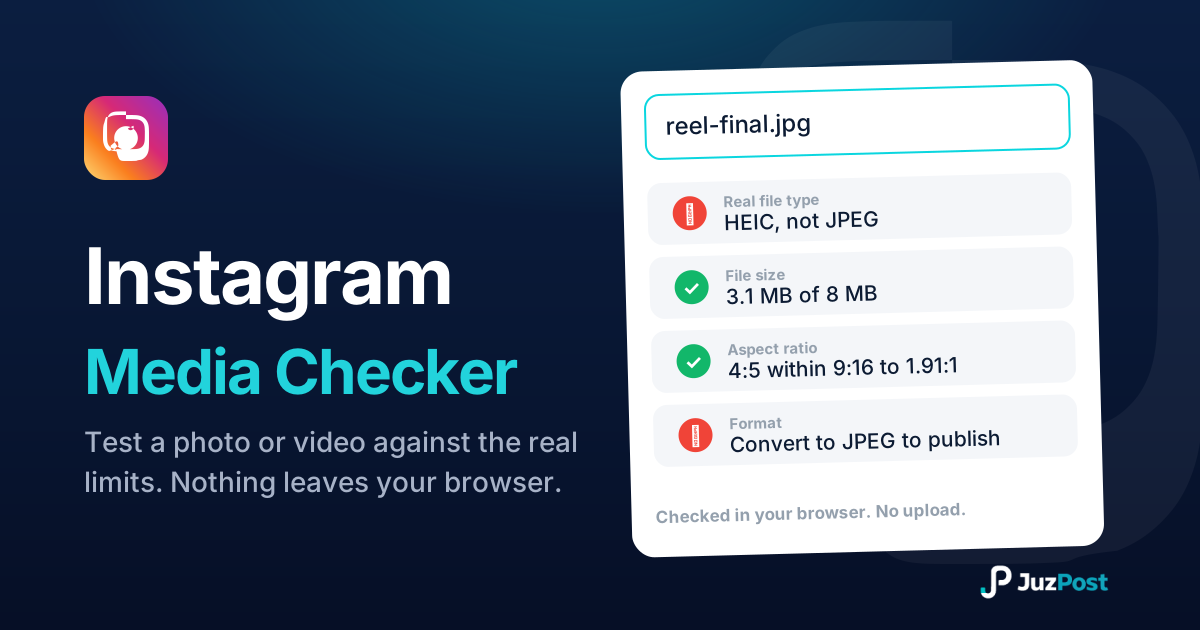
Drop a photo or video and see whether Instagram will accept it. Real file type, format, size, ratio and length, checked in your browser. Nothing is uploaded.
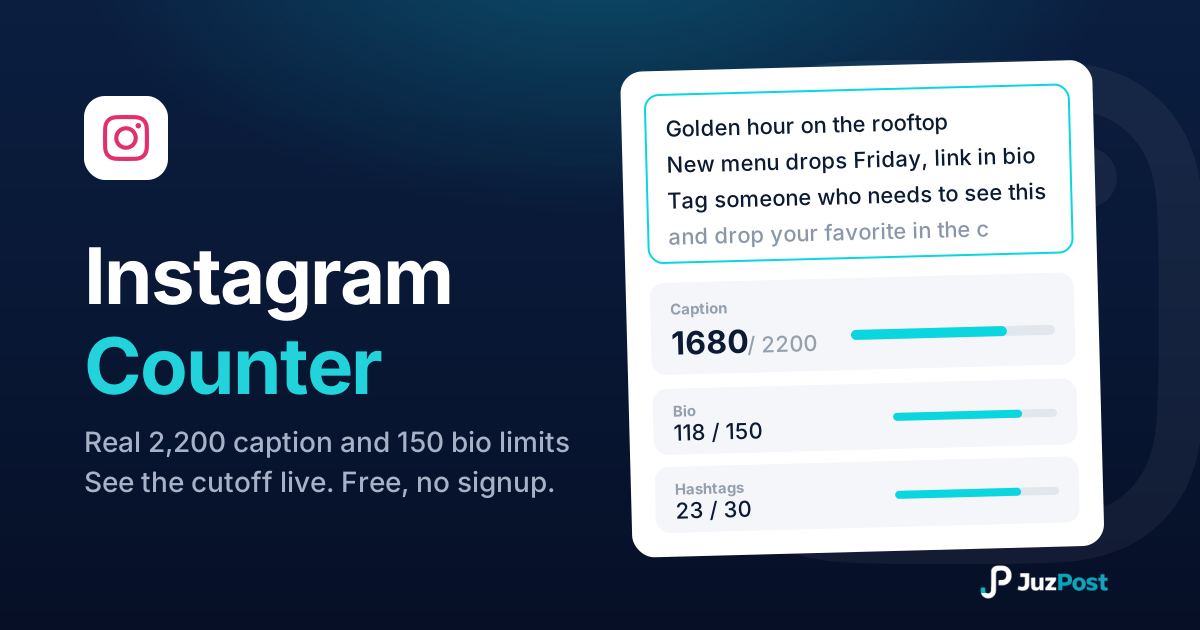
Count against Instagram’s real limits (2,200-character captions, 150-character bios) and see where the feed cuts you off at "…more".
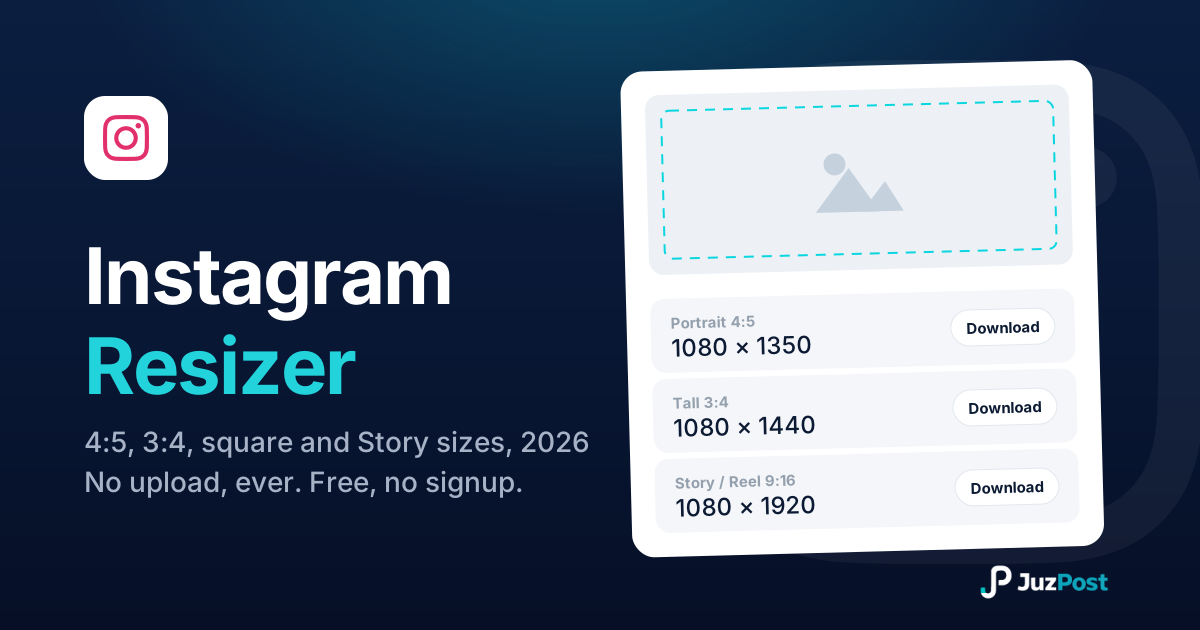
Resize photos to Instagram’s exact 2026 sizes, from 4:5 (1080×1350) to the new 3:4 (1080×1440), right in your browser. No upload, no signup.